Peatland fires explained: why Borneo’s danger runs underground
Visible flames can disappear before a peat fire is out. Here is how underground burning works—and what Borneo’s volunteer response reveals about prevention.
Verified brief
The story in 60 seconds
Peatland fires burn organic material in the soil, not only vegetation above it. They can smoulder underground and later reignite at the surface. BBC reporting from Borneo on September 7 describes volunteers confronting that difficult, smoky emergency. Our analysis: judging progress requires more than counting visible flames; the condition of the peat and the support available to responders matter too.
This brief and the full story below are based on the disclosed sources. SearchTrends Daily’s interpretation appears later under “Our take.”
Full reporting
The complete story
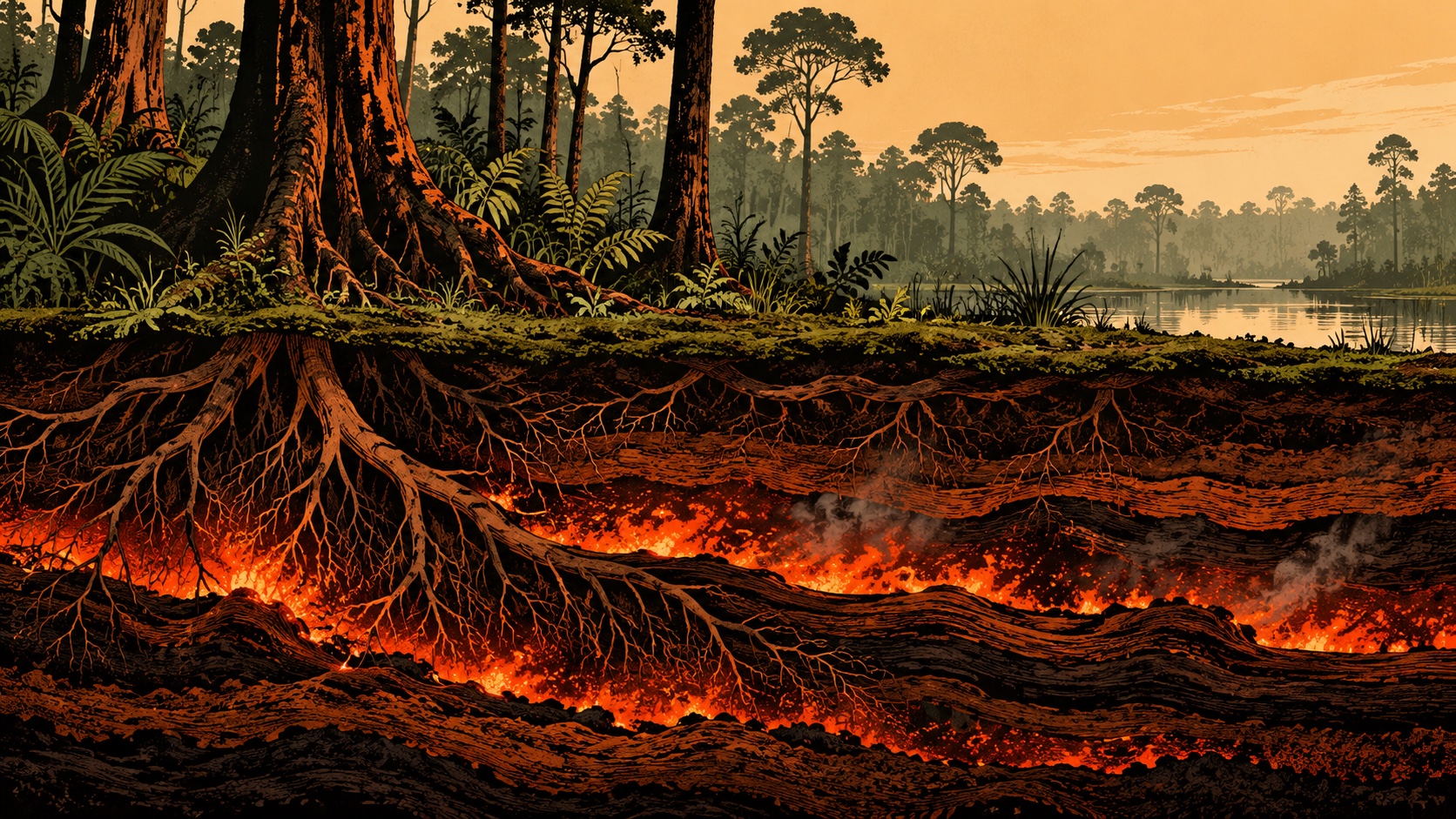
What is a peatland fire? It is a fire in soil rich in accumulated organic material. Imperial College London researchers explain that this fuel can keep smouldering below ground after surface flames have gone. That makes a peat fire different from a fire confined to the vegetation above it: the ground can remain part of the problem.
The Borneo story. In their September 7, 2026 report from Banjarbaru, Kalimantan, the BBC’s Gavin Butler and Ahmad Dhani described volunteer crews using hand tools and portable pumps against fires across Indonesian Borneo. Their report put the area of forest and farmland burned since early July at around 200,000 hectares. That is the BBC’s dated estimate, not a new September 14 total. Volunteers including Dwi Sujatmoko described exhaustion, smoke and the difficulty of securing water.
Why can these fires return? Imperial’s explanation of its 2020 research describes smouldering that persists underground and can later reignite surface flames. Its simulations, checked against experiments, examined how moisture affects ignition and spread. The work found that wetter peat was less likely to sustain smouldering. It is background research about the mechanism, not a prediction of when the particular Borneo fires will end.
What does the reporting not establish? Neither that general mechanism nor an account from one fire front identifies the cause of every ignition. We are not assigning responsibility to a named community, company or individual without incident-specific evidence. The sources also do not give this article a verified date when all affected ground will be safe.
This September 14 revision expands the explanation of the existing story. It is not a live fire map, a new damage tally or an instruction for readers to enter a fire area.
Source perspectives
What other reporting adds
These are the reports, official records, and trend observations used to build the story. The note under each link explains exactly what it contributes.
Source reporting for the facts and attributed reactions. The separate analysis, editorial view and conditional outlook are SearchTrends Daily interpretations.
Read original source ↗Imperial College LondonCarbon-releasing ‘zombie fires’ in peatlands could be dampened by new findingsThe research institution’s October 30, 2020 explanation of its modelling study supports the distinction between surface flames and smouldering peat, the role of moisture and the difficulty of detecting or extinguishing underground burning. This is scientific background, not a September 2026 incident update or proof of any particular ignition source.
Read original source ↗SearchTrends Daily opinion
Our take
Analysis
What the evidence and search signal suggest
Our analysis: the useful question is not just how dramatic the flames look, but what evidence would show that the danger is receding. A smaller visible fire front, less persistent smoke and a reduction in underground burning are different observations. Treating any one of them as a substitute for the others risks declaring success too early.
That changes how we judge emergency response. The volunteers’ work is essential to the story, but their effort alone is not a measure of whether the surrounding landscape is becoming less vulnerable. The question for those responsible for longer-term protection is whether resources address both the immediate incident and the conditions that allow another one.
Moisture is central to the research, but that does not make prevention a one-line promise to add water. A credible plan needs clear responsibility, evidence about local conditions and a way to assess results over time. Announcing a restoration project and demonstrating that a site is less likely to burn are not the same achievement. This is the test we would apply to future announcements, not a claim that a particular project has failed.
The story also needs separate measures of harm. An area-burned estimate cannot by itself tell us how long neighbouring people were exposed to smoke or how much carbon was released from a particular depth of peat. We will not turn the BBC’s area figure into an unsupported emissions or health estimate. Better explanation means being precise about what each number can—and cannot—answer.
Analysis and commentary are SearchTrends Daily’s interpretation. They are intentionally separated from the sourced account above.
Meaning
Why this matters
The visible edge of a fire is not necessarily the edge of its consequences. Hidden burning can make a reassuring surface image a poor guide to whether an incident is over. That matters for how a newsroom describes progress, as well as for the communities and crews in the reporting.
The practical distinction for readers is between a report that flames have been suppressed and evidence that the underlying peat is no longer burning. This article cannot issue an all-clear; current instructions must come from the responsible local authorities.
Background
How we got here
Peat builds up when wet conditions slow the decomposition of plant material. Carbon that would otherwise return to the atmosphere remains stored in the ground. Drying and burning can undermine that store; the BBC’s account uses this history to explain why the Borneo fires have significance beyond the vegetation lost.
Imperial describes peat fires in Southeast Asia, North America and Siberia. Borneo is therefore a concrete case of a wider fire problem, not evidence that every peatland has the same conditions or needs an identical response.
Outlook
What is likely to happen next
The next substantive update should come from a dated incident assessment, air-quality report or a documented change in support or prevention. None of the material reviewed here justifies a forecast that the fires will end on a particular day. A new article timestamp should not be mistaken for a new assessment of conditions on the ground.
Our conditional outlook: if response improvements are accompanied by sustained attention to vulnerable peat and verified follow-up, that would strengthen the case for greater resilience. If the underlying conditions remain unchanged, a quieter news cycle would not itself show that the problem has been resolved. This is environmental analysis, not firefighting or medical advice.
A conditional editorial assessment based on the evidence available at the review date, not a guaranteed outcome.
Live record
Updates to this story
Peatland-fire explanation expanded with research and dated context
Expanded the original Borneo story to answer what peatland fires are, why underground burning can persist and what evidence would show meaningful progress. Added Imperial College London’s explanation of its 2020 research as scientific background. The BBC’s September 7 report and area-burned estimate remain explicitly dated; this is not a new September 14 incident tally. Added fuller original analysis, a clearer headline and search description while retaining the original publication date, article URL, author and reader discussion.
Commentary
What we think
SearchTrends Daily’s view: recognising volunteer courage should be the start of scrutiny, not its substitute. If a story stops at exhausted people working through smoke, it can leave readers admiring the response without asking what would reduce the burden on those responders next time.
The most useful follow-up is a concrete account of support and prevention: what changed, who is responsible and what evidence shows it helped. We would rather revisit those questions than repeatedly reuse the same dramatic imagery. Readers with relevant local knowledge can add a dated public source or a specific observation, but a comment is not proof that an area is safe.