Why white dwarf stars can look green, pink or purple
A new study calculates the colours of stellar remnants from their spectra. Its green-star finding is not a close-up photograph, and most white dwarfs still live up to their name.
Verified brief
The story in 60 seconds
Yes, some white dwarfs would look green, pink or purple to a nearby human observer, according to new research. The team translated stellar spectra into perceived colours; it did not photograph the stars from close range. Chemistry in unusually dense atmospheres changes the light that escapes.
This brief and the full story below are based on the disclosed sources. SearchTrends Daily’s interpretation appears later under “Our take.”
Full reporting
The complete story
A study published in RAS Techniques and Instruments on 15 October 2026 investigated the perceived colours of white dwarfs, using observed spectra and atmosphere models. Mark A. Hollands led the work with Boris T. Gänsicke, Pier-Emmanuel Tremblay and Detlev Koester. Reuters reported the findings on 16 October. These dates describe the publication and reporting, not a sudden change in the stars themselves.
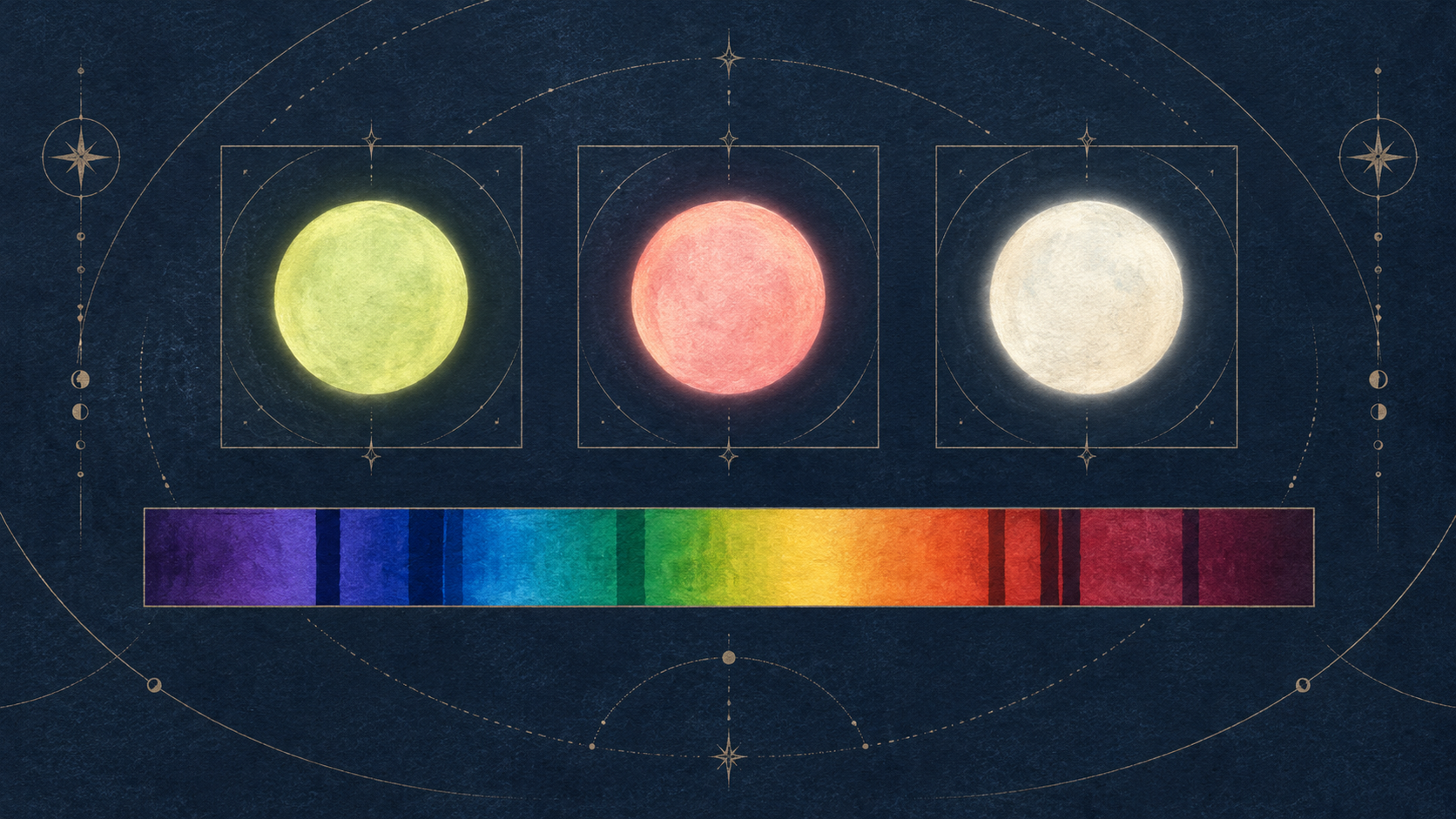
The striking example is WD J1330+6435. Reuters places it about 280 light-years away in Draco. Warwick says rocky debris from its planetary system has enriched its atmosphere with calcium, lithium and sodium. In the dense helium environment, sodium absorption spreads across a broad range of wavelengths rather than removing only a narrow orange band. The resulting balance of escaping light gives a chartreuse-green appearance in the calculation.
Other atmospheric mixtures produce other outcomes. Warwick describes carbon-rich examples as pink or purple, and cool mixed hydrogen–helium atmospheres as capable of cyan tones. The colour is therefore not simply a temperature label: what absorbs the light also matters.
The important qualification is how the result was obtained. The researchers combined spectra with a model of human colour response and translated the result into displayable colours. Their illustrations are calculated visualisations, not photographs taken beside the stars. The paper also warns that the green example has a noisy spectrum, so its precise shade could differ. The authors nevertheless find support for a green hue across alternative models.
Source perspectives
What other reporting adds
These are the reports, official records, and trend observations used to build the story. The note under each link explains exactly what it contributes.
Primary paper published 15 October 2026; read methods, atmospheric examples, local-sample analysis and conclusions. Supports spectrum-to-colour calculation, noisy-spectrum caveat and distinction between illustrative selections and a volume-limited sample. Open Access, CC BY 4.0.
Read original source ↗University of WarwickGreen, pink and purple: astronomers reveal the surprising true colours of white dwarf starsInstitutional account dated 15 October 2026. Supports the composition explanation, remnant context, historical brightness-selection bias and typical white appearance. This is the research institution’s account, not independent replication.
Read original source ↗ReutersNewly identified green star leaves astronomers amazedWill Dunham’s 16 October 2026 report, read in the normal browser. Independent reporting with researcher interviews; supports the distance and Draco location, not an independent experimental replication.
Read original source ↗SearchTrends Daily opinion
Our take
Analysis
What the evidence and search signal suggest
The finding answers two questions that should not be collapsed into one. Can a white dwarf depart from the usual orange–white–blue range? The spectra and calculations support that answer. Has someone directly seen this particular star as a large green disc? That is not what the study reports.
There is also a difference between demonstrating an unusual example and measuring how common the whole class is. The paper deliberately chose some extreme objects to explore the possible palette; that selection is not a census. Its separate nearby-volume analysis is the appropriate place to discuss typical colours.
Our conclusion is that “green star” is a useful doorway into the physics, provided the explanation travels with the headline. The absorbing atmosphere is the story, not evidence that ordinary temperature rules have become meaningless for every star.
Analysis and commentary are SearchTrends Daily’s interpretation. They are intentionally separated from the sourced account above.
Meaning
Why this matters
The immediate answer is about interpretation, not a new object to spot unaided tonight. A colourful image can represent a measurement translated for human vision, an artist’s impression or a false-colour map. Those are different products, even when all are useful.
Our reading is that the strength of this study is its explicit bridge between the light data and the appearance being claimed. That gives readers a better test than asking whether an accompanying picture looks convincing: what information went into the colour, and what assumptions stand between the spectrum and the screen?
Background
How we got here
White dwarfs are the dense remnants left after stars like the Sun exhaust their fuel and lose their outer layers. Their familiar name reflects the hot, white or pale-blue examples identified early on; it does not guarantee that every member has identical atmospheric chemistry or colour.
Warwick’s account explains another historical bias: hotter, bluer white dwarfs are brighter and easier to see at greater distances. A brightness-selected collection can therefore give a different impression from a sample defined by a nearby volume. In the study’s local sample, the median correlated colour temperature was about 6,800 kelvin—essentially white. The unusual examples do not overturn that typical picture.
Outlook
What is likely to happen next
Better-quality spectra and independent colour calculations could sharpen or change the classification of the green example. We would revise our assessment if those data moved it outside the green region, or if a correction changed the method or its interpretation.
A larger, consistently selected sample would be needed to strengthen population-wide estimates. Until then, the useful takeaway is modest: some unusual white dwarf atmospheres can produce unexpected perceived colours, while the typical nearby example remains white. Nothing here requires a newly transformed star, a close-up photograph or a prediction about what observers will see tonight.
A conditional editorial assessment based on the evidence available at the review date, not a guaranteed outcome.
Live record
Updates to this story
No material updates yet.



Commentary
What we think
SearchTrends Daily opinion: this is a genuinely engaging result without needing a science-fiction embellishment. Showing how researchers infer an appearance is more interesting than presenting a rendering as a camera view.
We would also keep “first” claims attributed to the researchers and open to revision. A striking classification deserves attention, but an exact shade, a universal frequency and an absolute historical first are different claims with different evidential burdens. Our own hero is a symbolic editorial illustration, not the team’s calibrated output.