Webb traces farthest known fast radio burst to a young dwarf galaxy
A short radio flash from the early universe led astronomers to a small star-forming galaxy. The host makes a young magnetar plausible, without solving the mystery.
Verified brief
The story in 60 seconds
MeerKAT detected FRB 20240304B; Webb measured its host galaxy at redshift 2.148. The finding reaches back to roughly three billion years after the Big Bang.
This brief and the full story below are based on the disclosed sources. SearchTrends Daily’s interpretation appears later under “Our take.”
Full reporting
The complete story
Astronomers have located the host galaxy of the most distant fast radio burst identified so far, FRB 20240304B. The MeerTRAP project detected the millisecond-long radio flash with South Africa’s MeerKAT radio telescope in March 2024. NASA says the James Webb Space Telescope then found a faint galaxy at the burst’s position and measured its redshift as 2.148, placing the event in an era roughly three billion years after the Big Bang.
The surprise was the host. Researchers expected a much larger galaxy, but Webb found a small dwarf galaxy actively forming stars. NASA reports that its mass was about 1,000 times below the team’s expectation. That young environment makes a source with a short formation time, such as a magnetar, more plausible for this burst than a long-delayed merger of neutron stars. The observation does not prove a magnetar caused it, and astronomers still do not know the origin of fast radio bursts as a class.
The findings were reported in Science. NASA’s account: https://science.nasa.gov/missions/webb/webb-measures-distance-to-farthest-fast-radio-burst-suggesting-origin/ . Author preprint: https://arxiv.org/abs/2508.01648 .
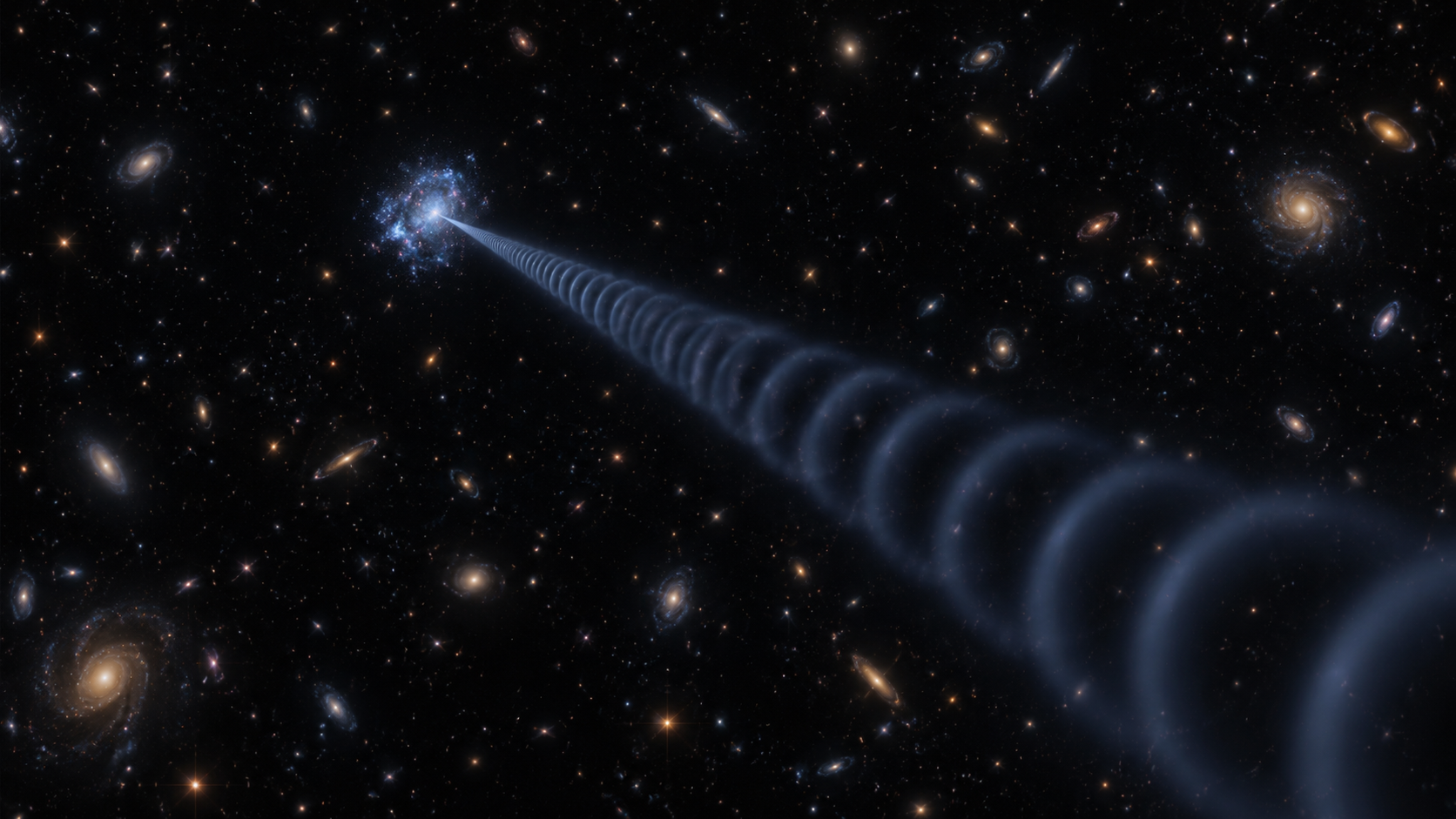
Image: Original AI-generated conceptual illustration for SearchTrends Daily, not a telescope photograph of FRB 20240304B.
Source perspectives
What other reporting adds
These are the reports, official records, and trend observations used to build the story. The note under each link explains exactly what it contributes.
Primary mission account gives the redshift, host-galaxy observations and limits of the magnetar interpretation.
Read original source ↗arXiv / Caleb et al.A fast radio burst from the first 3 billion years of the UniverseResearch preprint describes the burst detection, redshift and small star-forming host galaxy.
Read original source ↗SearchTrends Daily opinion
Our take
Analysis
What the evidence and search signal suggest
The evidence is strongest for the distance and identity of the young host galaxy. The interpretation of the engine behind the flash is weaker: a rapidly forming stellar population fits a magnetar scenario, but one host cannot rule out every other production route.
Analysis and commentary are SearchTrends Daily’s interpretation. They are intentionally separated from the sourced account above.
Meaning
Why this matters
The host gives researchers a rare view of a radio burst in the early universe and a better test of competing ideas about what produces them. The burst’s signal also carries information about matter along the long path to Earth, potentially helping astronomers map otherwise hard-to-see cosmic structure.
Background
How we got here
Fast radio bursts were first identified in 2007. They last only milliseconds and many never repeat, making both their sources and host galaxies difficult to pin down. MeerKAT localized this event precisely enough for Webb to search the right patch of sky. Webb’s infrared observations provided the distance measurement that ground-based follow-up could not.
Outlook
What is likely to happen next
The team expects MeerKAT and future radio facilities to find more distant, precisely localized bursts. Webb could then measure additional host galaxies. A larger sample may test whether youthful hosts are common and whether the magnetar interpretation holds up; the next discoveries could also challenge it.
A conditional editorial assessment based on the evidence available at the review date, not a guaranteed outcome.
Live record
Updates to this story
No material updates yet.



Commentary
What we think
A record distance is the headline, but the more useful result is the unexpectedly small host. It forces source models to account for bursts in young, low-mass galaxies rather than treating large mature hosts as the default.