SpaceX Dragon launches for space station with final solar-array pair and research cargo
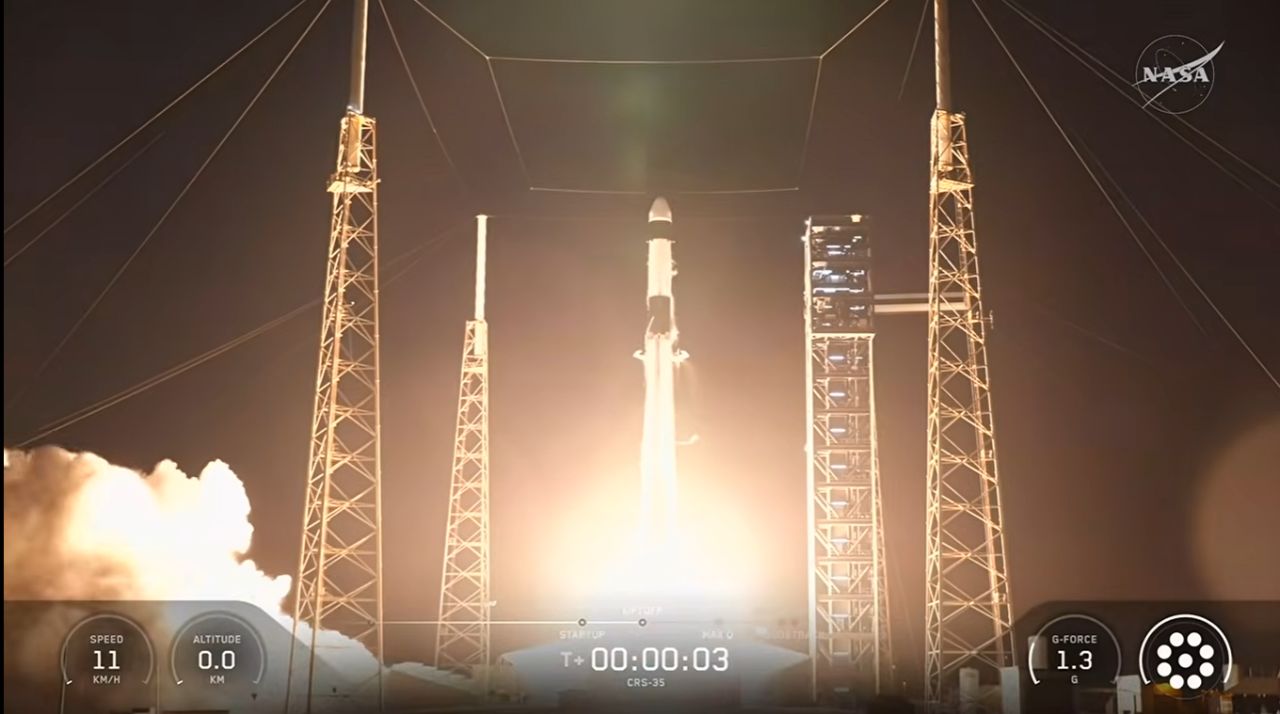
NASA says the CRS-35 cargo flight lifted off from Cape Canaveral with more than 6,300 pounds of supplies. Docking is still ahead.
Verified brief
The story in 60 seconds
A SpaceX Falcon 9 launched a Dragon cargo capsule toward the International Space Station on 13 October. NASA says the flight carries the final pair of roll-out solar arrays and new experiments; docking is scheduled for 15 October.
This brief and the full story below are based on the disclosed sources. SearchTrends Daily’s interpretation appears later under “Our take.”
Full reporting
The complete story
A SpaceX Falcon 9 carrying a Dragon cargo spacecraft lifted off at 6:33 a.m. EDT on 13 October from Space Launch Complex 40 at Cape Canaveral Space Force Station, NASA said. The flight is SpaceX’s 35th commercial resupply mission for the International Space Station. NASA reports more than 6,300 pounds of supplies and hardware aboard. A successful launch puts Dragon on its way; it does not mean docking or cargo delivery has already happened.
The cargo includes the final pair of International Space Station Roll-Out Solar Arrays. NASA says astronauts plan to install them during spacewalks later this autumn, increasing available power for research and operations. The spacecraft is also carrying investigations involving artificial-retina manufacturing, three-dimensional heart tissue, specialised glass and brain organoids. These are research projects, not finished medical treatments.
Dragon is scheduled to dock autonomously with the space-facing port of the Harmony module at about 11 a.m. EDT on Thursday, 15 October. NASA plans to begin coverage at 9:15 a.m. EDT. The agency says Dragon is expected to remain at the station until mid-November, then bring time-sensitive research and other cargo back to Earth. Source: https://www.nasa.gov/news-release/nasa-science-cargo-launch-on-35th-spacex-resupply-mission-to-station/
Source perspectives
What other reporting adds
These are the reports, official records, and trend observations used to build the story. The note under each link explains exactly what it contributes.
NASA primary release confirming launch time, cargo weight, solar arrays, research payload and planned docking.
Read original source ↗SpaceXCRS-35 mission pageMission operator page for the CRS-35 launch and Dragon spacecraft.
Read original source ↗NASANASA images and media usage guidelinesNASA permits factual editorial use of its credited mission image with source acknowledgement and no implied endorsement.
Read original source ↗SearchTrends Daily opinion
Our take
Analysis
What the evidence and search signal suggest
Searches for “rocket launch today” can make a cargo flight look like a single moment. The useful timeline has three stages: launch, rendezvous and docking, then installation or operation of the delivered hardware. NASA has confirmed the first stage. Its scheduled docking and solar-array spacewalks remain future events as of this review.
Analysis and commentary are SearchTrends Daily’s interpretation. They are intentionally separated from the sourced account above.
Meaning
Why this matters
The final solar-array pair matters because the station’s experiments, life-support systems and operations all depend on electrical capacity. The cargo also shows why routine supply flights remain scientifically significant: equipment must reach orbit before researchers can test whether promising ideas work in microgravity. The mission’s immediate success measure now shifts from launch to safe arrival and unloading.
Background
How we got here
NASA contracts SpaceX to carry cargo to the station under its Commercial Resupply Services programme. SpaceX’s prelaunch mission page identified this Dragon as a spacecraft previously used on three resupply flights. Reuse is part of the programme’s operating model, but each flight still has distinct payloads and milestones. Source: https://www.spacex.com/launches/crs35
Outlook
What is likely to happen next
Watch NASA’s live coverage and station updates for Dragon’s planned 15 October docking. Crew members will then unload supplies and prepare experiments. The new arrays still require installation on later spacewalks, which NASA says are planned for the autumn.
A conditional editorial assessment based on the evidence available at the review date, not a guaranteed outcome.
Live record
Updates to this story
No material updates yet.


Commentary
What we think
Editorial view: the headline science is compelling, but it should be described at the right stage. A laboratory experiment on a spacecraft is an opportunity to learn, not a promised therapy. Likewise, a successful liftoff is newsworthy without implying the station has already received the cargo. Hero image: NASA photograph of the actual 13 October 2026 CRS-35 Falcon 9 launch, used editorially under NASA’s media usage guidelines; no endorsement implied.