Melbourne earthquake: what is confirmed about the magnitude-4.8 Leongatha tremor
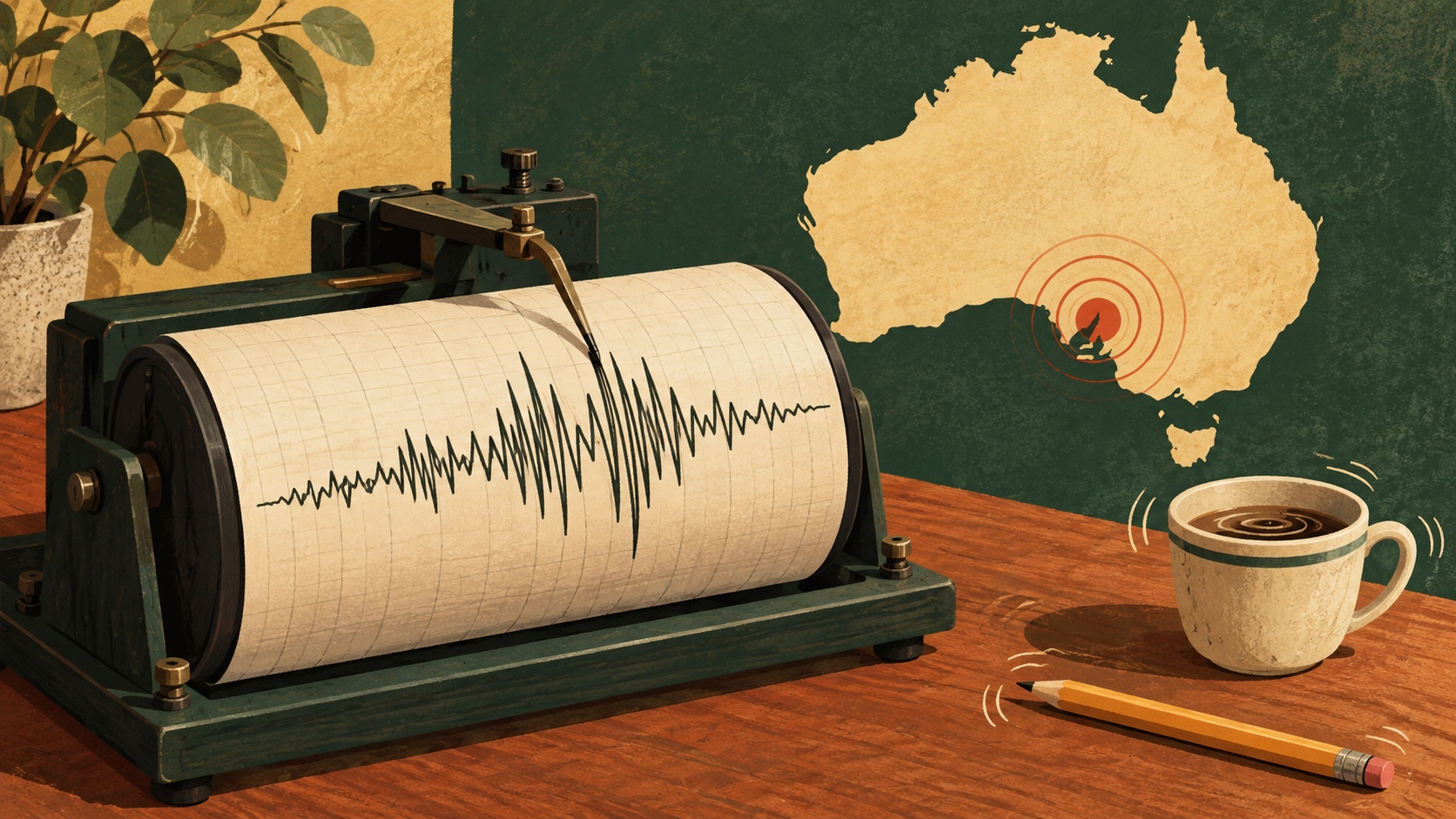
Geoscience Australia recorded a felt magnitude-4.8 earthquake near Leongatha at 2:01 a.m. local time on October 3, followed by a confirmed magnitude-3.1 aftershock and a later magnitude-2.5 event nearby.
Verified brief
The story in 60 seconds
A magnitude-4.8 earthquake occurred near Leongatha in Victoria at 2:01:39 a.m. local time on Saturday, October 3, at a listed depth of 10 kilometres, Geoscience Australia says. Victoria State Emergency Service later said there was no immediate threat and no action was required. An official expert confirmed a magnitude-3.1 aftershock, and the live catalogue subsequently added a felt magnitude-2.5 event near Leongatha at 12:25:13 p.m. No injuries or damage had been reported in the latest ABC update reviewed for this story.
This brief and the full story below are based on the disclosed sources. SearchTrends Daily’s interpretation appears later under “Our take.”
Full reporting
The complete story
Geoscience Australia's Earthquakes@GA service lists event ga2026tnibno near Leongatha, Victoria, with a magnitude of 4.8 MLa and a depth of 10 kilometres. The origin time was 16:01:39 UTC on October 2, which the official event panel converts to 2:01:39 a.m. local epicentral time on October 3. The catalogue marks the event as felt and gives coordinates of 38.40 degrees south, 145.86 degrees east.
A magnitude-3.1 event followed near Leongatha at 2:56:33 a.m. Geoscience Australia geophysicist Hadi Ghasemi later confirmed to ABC News that it was an aftershock. ABC reported that Geoscience Australia had received more than 16,000 felt reports by 3 a.m., and that there were no reports of injuries or damage. Victoria State Emergency Service issued a community update saying there was no immediate threat and no action was required, while advising people to check for hazards and remain prepared for possible further aftershocks.
The official catalogue later added another felt event, ga2026tocwfc, near Leongatha at 12:25:13 p.m. local time. It was listed as magnitude 2.5, seven kilometres deep, at coordinates 38.36 degrees south and 145.86 degrees east. At this review cutoff, the catalogue had not labelled that event's relationship to the main shock, so we describe it as a later nearby event rather than assigning a sequence classification ourselves.
People across the wider Melbourne region began searching for earthquake information immediately after the shaking. That search activity explains the sudden public attention; it is not evidence of damage or a measure of the quake's physical intensity at every location.
Source perspectives
What other reporting adds
These are the reports, official records, and trend observations used to build the story. The note under each link explains exactly what it contributes.
Live official catalogue entries for the magnitude-4.8 event ga2026tnibno and the later magnitude-3.1 event ga2026tnjxcx near Leongatha, including times, depth, coordinates and felt status.
Read original source ↗VicEmergencyIncidents and WarningsOfficial Victorian dashboard checked at approximately 3:50 a.m. local time; it displayed zero current warnings and zero incidents at that cutoff.
Read original source ↗Victoria State Emergency ServiceEarthquake — how to stay safeOfficial during- and after-earthquake safety instructions, emergency contact numbers and advice about possible aftershocks.
Read original source ↗Geoscience AustraliaNational Earthquake Alerts CentreExplains Australia's 24-hour official earthquake monitoring, alert thresholds, review stages, felt reports and ShakeMaps.
Read original source ↗Geoscience AustraliaEarthquake information for media outletsOfficial guidance on earthquake terminology, magnitude revisions and the frequency of earthquakes in Australia.
Read original source ↗VicEmergency / Victoria State Emergency ServiceCommunity Update — Leongatha earthquakeOfficial community update confirming the magnitude-4.8 earthquake and magnitude-3.1 aftershock, with a no-immediate-threat assessment and safety instructions.
Read original source ↗ABC NewsMagnitude-4.8 earthquake strikes near Leongatha, south-east of MelbourneUpdated independent reporting with Geoscience Australia expert confirmation of the magnitude-3.1 aftershock, more than 16,000 felt reports and no reported injuries or damage.
Read original source ↗SearchTrends Daily opinion
Our take
Analysis
What the evidence and search signal suggest
For anyone who felt the quake, the best immediate response is to check people first, then hazards. Victoria State Emergency Service advises avoiding damaged buildings, fallen or damaged trees and powerlines, and blocked or damaged roads. If a property appears damaged, electricity, gas and water services should be checked by a licensed technician before use.
If shaking starts again indoors, the official advice is to drop to the ground, take cover under sturdy furniture and hold on until it stops. Stay away from glass and objects that could fall, do not use lifts, and do not run outside during the shaking. Outdoors, move away from buildings, streetlights and utility wires. Call Triple Zero for a life-threatening emergency and VICSES on 132 500 for earthquake emergency assistance.
The confirmed magnitude-3.1 aftershock and later magnitude-2.5 event are reasons to remain attentive, not a basis for predicting a larger quake. Ghasemi told ABC that aftershocks are possible and generally become less frequent with time. That is a population-level pattern, not a precise forecast for this sequence.
Analysis and commentary are SearchTrends Daily’s interpretation. They are intentionally separated from the sourced account above.
Meaning
Why this matters
The first questions after a felt earthquake are practical: where was it, how large was it, is there an official warning, and what should people do if shaking resumes? The authoritative answers can change as seismic stations provide more data. Geoscience Australia says earthquake solutions go through initial, interim and final review, so magnitude, depth and location may be refined.
The official state message is now clearer than it was in the first hour. Victoria State Emergency Service's community update said there was no immediate threat to the community and no action was required. It also said that, unless circumstances changed, the message would be the last issued for this earthquake. That does not guarantee that no isolated property damage exists; it records the emergency authority's assessment at the time.
ABC's updated report said no injuries or damage had been reported and quoted a Geoscience Australia expert who did not expect major damage. Reports from residents remain useful for mapping where shaking was felt, and Geoscience Australia invites felt reports, but personal accounts alone do not verify structural safety.
Background
How we got here
Update — October 3, 2026, 2:52 p.m. local time: This story now includes the State Emergency Service's no-immediate-threat community update, Geoscience Australia's confirmation that the magnitude-3.1 event was an aftershock, the latest no-injury/no-damage reporting, and a later felt magnitude-2.5 event added to the official catalogue. The original publication time and stable URL are unchanged.
Earthquakes are not unusual in Victoria even though Australia lies within a tectonic plate rather than on a modern plate boundary. Victoria State Emergency Service says earthquakes occur as stress builds in rocks along fault planes, and Geoscience Australia notes that most Australian earthquakes create only minor shaking or occur in sparsely populated areas.
The National Earthquake Alerts Centre is Australia's 24-hour official earthquake monitoring service. It publishes rapid information and can refine an event as more observations are analysed. That process is why a precise timestamp and event ID are more useful than treating the first magnitude shared online as permanent.
The magnitude-4.8 event should also be kept in proportion. It is materially smaller than Victoria's magnitude-5.9 earthquake of September 2021. Comparisons should not be used to dismiss a person's experience or to predict damage; local geology, depth, distance and building conditions all affect shaking.
Outlook
What is likely to happen next
Geoscience Australia may still revise the magnitude, depth, coordinates or solution status as the events move through review. Emergency authorities could issue a new message if conditions change, despite the State Emergency Service saying its community update would otherwise be the last for this earthquake. We will update the same URL if official records materially change, if injuries or significant damage are confirmed, or if Geoscience Australia characterises additional events in the sequence.
For now, readers should monitor Earthquakes@GA and VicEmergency, submit a felt report if appropriate, photograph any damage only when it is safe to do so, and follow emergency-service directions. The no-immediate-threat assessment and absence of reported injuries or damage are timestamped findings, not promises about every property or future event.
A conditional editorial assessment based on the evidence available at the review date, not a guaranteed outcome.
Live record
Updates to this story
No material updates yet.

Commentary
What we think
SearchTrends Daily opinion: The responsible framing remains narrow and updateable. A magnitude-4.8 earthquake near Leongatha is confirmed; the magnitude-3.1 event is now officially described as an aftershock; a later magnitude-2.5 event is in the catalogue; and the State Emergency Service said there was no immediate threat. Anything beyond that — a final damage estimate, a classification of every later tremor or a prediction of what comes next — requires further official evidence. The useful service is to give readers event identifiers, exact times, live official links and safety actions without turning understandable alarm into unsupported catastrophe language.