IndiGo flight diverts after cabin device smoke: what power-bank rules say
Flight 6E 6115 landed safely in Hyderabad after smoke from a passenger device. Reports identified a power bank; India already restricts their in-flight use.
Verified brief
The story in 60 seconds
An IndiGo Delhi–Chennai flight diverted to Hyderabad on 11 October after smoke from a passenger’s electronic device. IndiGo said crew contained the situation and the aircraft landed safely. Reports identified a power bank, while the airline’s statement did not specify the device type.
This brief and the full story below are based on the disclosed sources. SearchTrends Daily’s interpretation appears later under “Our take.”
Full reporting
The complete story
An IndiGo flight from Delhi to Chennai diverted to Hyderabad on 11 October 2026 after smoke was detected from a passenger’s personal electronic device. The airline identified the flight as 6E 6115 and said its cabin crew brought the situation under control before the pilots diverted and landed safely at Rajiv Gandhi International Airport. Hindustan Times reported that 191 people were aboard and that the aircraft later continued to Chennai.
The wording matters. IndiGo’s statement, carried by Hindustan Times and NDTV, calls the source a personal electronic device. Both reports identify it as a power bank, but the statement quoted in those accounts does not independently name the device or explain why it overheated. There is no basis in the available reporting to assign fault to the passenger, the battery maker or the crew.
India already has a restriction aimed at this risk. In a March 2026 answer to the Rajya Sabha, the Ministry of Civil Aviation said the Directorate General of Civil Aviation issued a November 2025 advisory telling airlines to prohibit the use of power banks for charging devices during flight. That is a rule about in-flight use, not a blanket ban on carrying all power banks. International Air Transport Association guidance describes the wider concern as thermal runaway, a battery failure that can produce intense heat and smoke.
For travelers, the practical lesson is to check the operating airline’s current battery policy before flying, keep a power bank out of checked baggage, and alert cabin crew immediately if a device becomes hot, swells or smokes. The US Federal Aviation Administration says spare lithium batteries, including power banks, belong in carry-on baggage rather than checked luggage and must be protected from damage and short circuits. Airline-specific and national rules can be stricter.
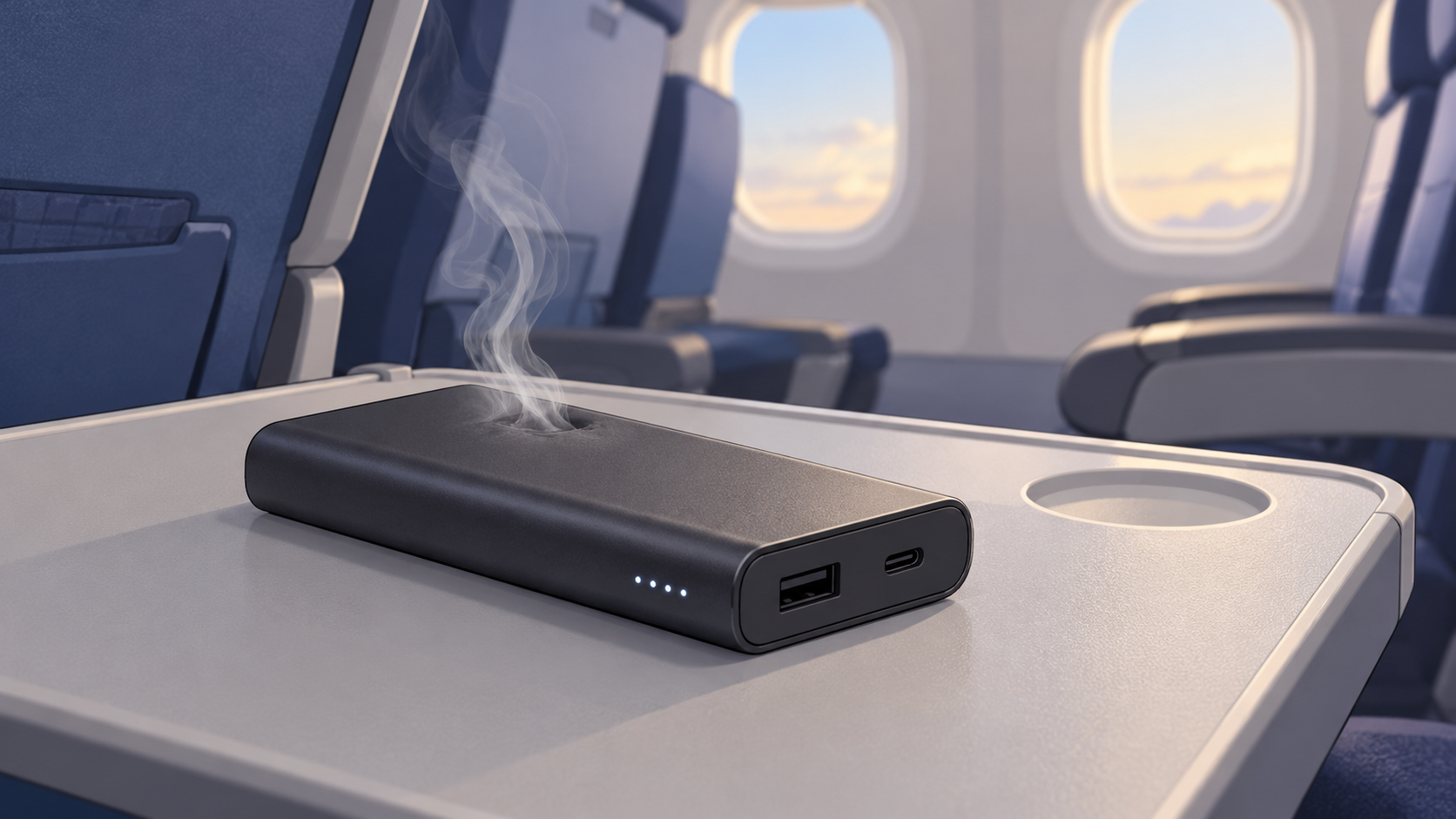
Hero image: original AI-generated illustration for SearchTrends Daily; it does not depict flight 6E 6115, its passengers or the actual device.
Source perspectives
What other reporting adds
These are the reports, official records, and trend observations used to build the story. The note under each link explains exactly what it contributes.
Contemporaneous report carrying IndiGo’s statement on the flight, crew response and safe diversion; reports 191 people aboard and identifies the device as a power bank.
Read original source ↗India Ministry of Civil Aviation / Rajya SabhaWritten answer 1801: ban of power bank usage and lithium battery in flightPrimary government record confirming the November 2025 DGCA advisory and its restriction on using power banks to charge devices in flight.
Read original source ↗International Air Transport AssociationGuidance Document for Operators – Power Banks – 2026Primary industry safety guidance explaining thermal runaway risk and 2026 power-bank carriage and use provisions.
Read original source ↗US Federal Aviation AdministrationAirline Passengers and BatteriesPrimary passenger guidance on carrying spare lithium batteries and power banks in the cabin, not checked baggage, and protecting them from damage. US rules; travelers must check their operating airline and route.
Read original source ↗SearchTrends Daily opinion
Our take
Analysis
What the evidence and search signal suggest
The available evidence supports a narrow conclusion: smoke from a passenger device prompted a precautionary diversion, and the flight landed safely. It does not establish the battery’s brand, condition, precise failure mechanism or whether anyone broke a rule. The stronger public-service angle is the distinction between carrying a power bank, using it in flight and where it is stored.
Analysis and commentary are SearchTrends Daily’s interpretation. They are intentionally separated from the sourced account above.
Meaning
Why this matters
A small battery fault becomes a cabin safety event when it produces smoke during flight. This diversion shows why crews must be able to see and respond to an overheating device quickly. It also exposes a common point of confusion: permission to carry a power bank in the cabin does not mean permission to use it to charge a phone on every airline or route. Travelers should follow the rules of the operating carrier and the jurisdiction of their flight.
Background
How we got here
The Indian government told Parliament in March that the DGCA’s November 2025 advisory followed lithium-battery incidents and that the first such incident reported to the regulator was on 19 October 2025. IATA issued updated operator guidance in 2026 on power-bank carriage and use. Those policies predate this IndiGo diversion; the October incident is therefore not the first time regulators have confronted this hazard.
Outlook
What is likely to happen next
The airline or aviation regulator may release more details on the device and investigation. Until then, descriptions of the exact cause should remain provisional. Travelers can review the operating carrier’s published policy before their next flight and avoid assuming that another airline’s allowance applies.
A conditional editorial assessment based on the evidence available at the review date, not a guaranteed outcome.
Live record
Updates to this story
No material updates yet.


Commentary
What we think
Our view: airlines should state battery rules plainly at booking, check-in and boarding, then reinforce them in the cabin. A rule that passengers discover only after a problem starts has much less preventive value.