French supermarket fridge hack spoils food and exposes a hidden cyber risk
A cyberattack drove refrigeration systems in around 150 French stores to dangerous temperatures. Investigators are examining how the connected controls were reached.
Verified brief
The story in 60 seconds
French supermarket operators say attackers manipulated connected refrigeration equipment, forcing food to be discarded and causing some fires. The affected stores were mainly in the Intermarché network. French cyber authorities are investigating; the entry point and any connection to previously disclosed flaws remain unconfirmed.
This brief and the full story below are based on the disclosed sources. SearchTrends Daily’s interpretation appears later under “Our take.”
Full reporting
The complete story
A cyberattack against connected refrigeration systems disrupted roughly 150 French supermarkets, according to Les Mousquetaires, the group behind Intermarché. Reuters reported on 12 October that the equipment in some stores was driven to 50°C for about six hours. The temperature rise spoiled refrigerated stock, and the French prosecutor said the incident had also caused fires. Coopérative U said stores in its network were affected as well. The companies and authorities have not published a complete store-by-store accounting of losses.
The French national cybersecurity agency, ANSSI, said it was mobilized to help investigate. Danfoss, whose controls were used in affected systems, said the compromised devices ran older firmware. That statement does not identify the attackers or establish how they entered the systems. As of this review, there is no public evidence that the specific Danfoss weaknesses disclosed by researchers in August were used in this attack.
The immediate operational response was to discard food that could no longer be kept at safe temperatures and restore control of the equipment. The story matters beyond the affected retailers because modern cold chains rely on networked controllers to monitor temperatures, alert maintenance teams and manage energy use. When those controls are exposed or poorly maintained, a digital breach can become a physical food-safety and fire problem.
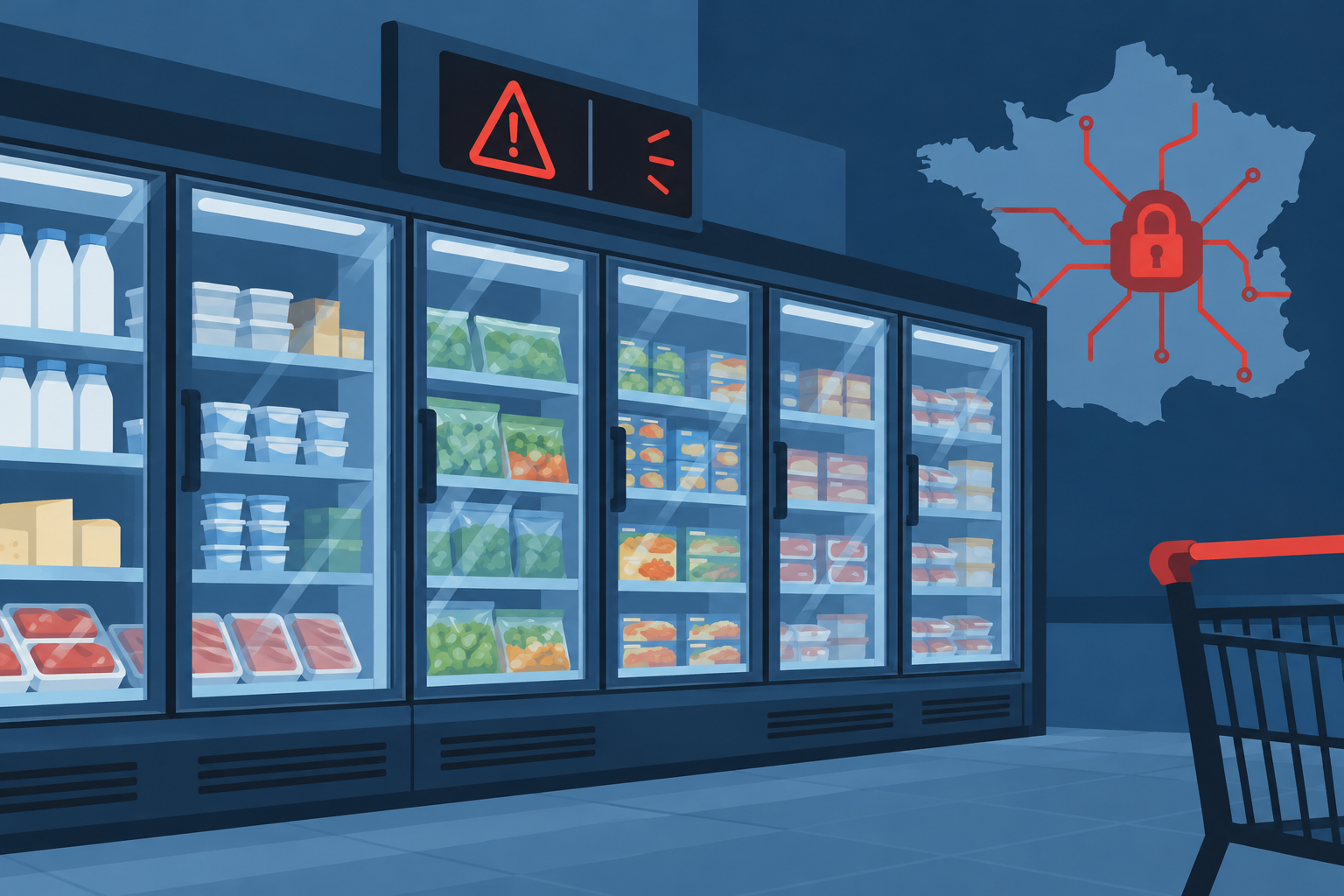
Image: SearchTrends Daily conceptual editorial illustration generated with OpenAI. It depicts a generic supermarket refrigeration aisle and a warning symbol, not a photograph of an affected French store.
Source perspectives
What other reporting adds
These are the reports, official records, and trend observations used to build the story. The note under each link explains exactly what it contributes.
Core reporting on Les Mousquetaires and Coopérative U statements, prosecutors, affected stores, temperatures, fires and food losses.
Read original source ↗The RecordCyberattack disrupts refrigeration in FranceIndependent reporting quoting ANSSI confirmation that it was mobilized to assist; attack method remains unconfirmed.
Read original source ↗Claroty Team82Freeze the Controller, Defrost the Food: Uncovering Vulnerabilities in Danfoss Refrigeration ControllersPrimary August security research explaining the class of networked refrigeration controller flaws and patch availability. No evidence these vulnerabilities caused the October attack.
Read original source ↗SearchTrends Daily opinion
Our take
Analysis
What the evidence and search signal suggest
The verified account points to a serious breach of operational technology, but the mechanics remain unresolved. The key questions are whether attackers used a known software flaw, obtained credentials, or entered through another connected service; which controller models and firmware versions were involved; and how many businesses outside the named chains are exposed. Answers will affect whether this remains a contained retail incident or prompts a wider patching and network-segmentation push. That is an inference about possible responses, not an announced regulatory action.
Analysis and commentary are SearchTrends Daily’s interpretation. They are intentionally separated from the sourced account above.
Meaning
Why this matters
Refrigeration is a food-safety system, not just a convenience for retailers. A prolonged temperature rise can require entire sections of stock to be thrown away. The reported fires underline that remote manipulation of industrial controls can create physical damage. The loss falls first on stores, suppliers and shoppers, while investigators must establish which systems were exposed and whether any similar installations remain vulnerable.
Background
How we got here
Commercial refrigeration systems commonly connect sensors and controllers to management networks so operators can monitor temperatures and diagnose faults remotely. In August, security researchers at Claroty published vulnerabilities in Danfoss AK-SM 800A controllers and said updated firmware was available. Their research described thousands of internet-exposed devices. It is relevant background to the sector, but it has not been tied to the October French attack. Danfoss has referred to outdated firmware in affected installations; the precise route into those systems is still under investigation.
Outlook
What is likely to happen next
ANSSI and French investigators are examining the intrusion. Retailers may disclose more detailed loss figures and restoration timelines. Danfoss and store operators may also identify the affected device versions and remediation steps. Any claim about the attackers or the method should be treated as unverified until investigators or the companies provide evidence.
A conditional editorial assessment based on the evidence available at the review date, not a guaranteed outcome.
Live record
Updates to this story
No material updates yet.



Commentary
What we think
SearchTrends Daily opinion: Retailers should treat refrigeration controllers as critical infrastructure within a store. Remote access needs an owner, prompt updates and a clear isolation plan. The public deserves prompt, specific explanations when equipment failures force food disposal, while investigators should avoid claiming a technical cause before the forensic work is complete.