Australia daylight saving: October 4 has passed, April 4 is next
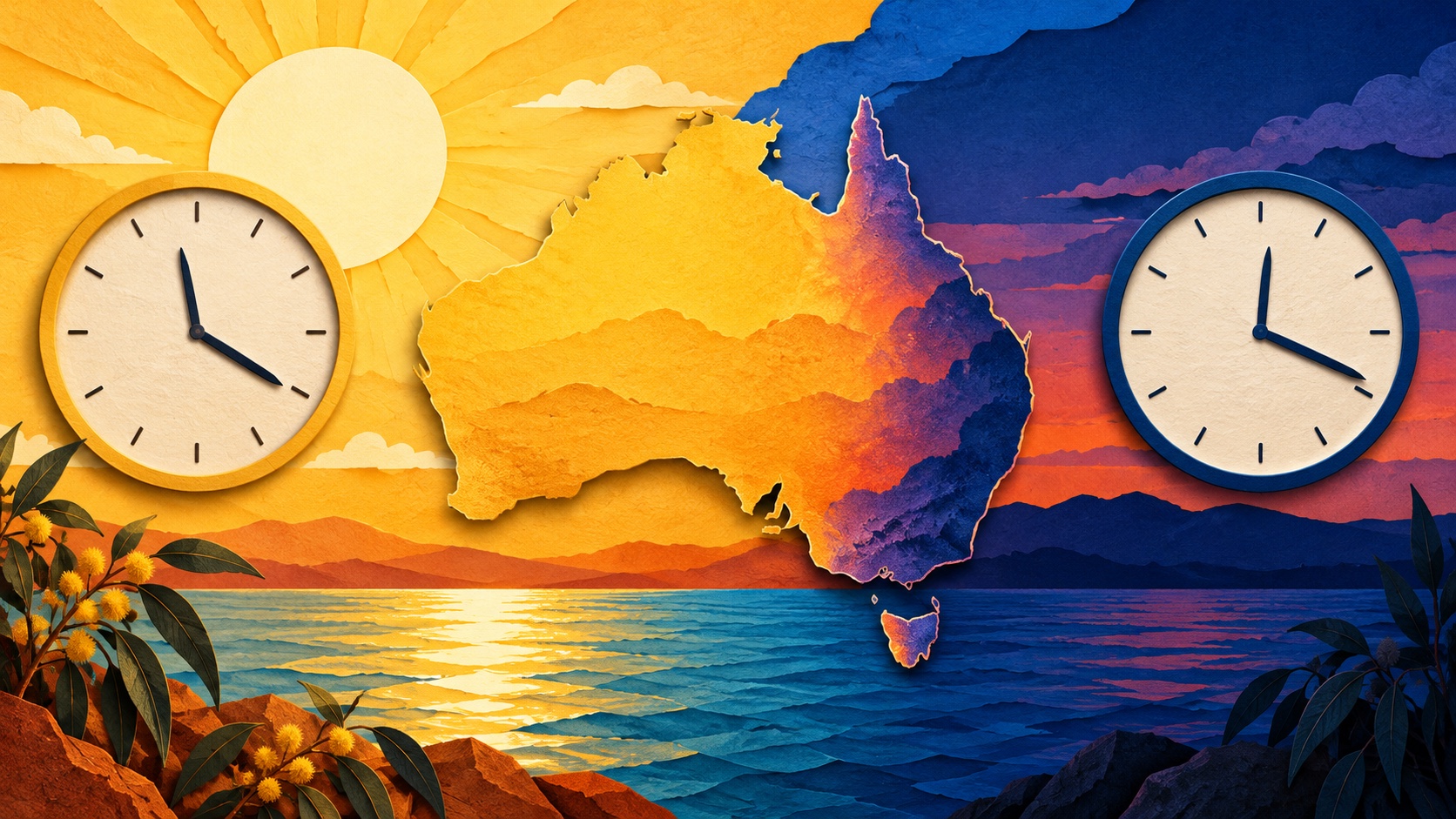
Daylight saving is now in effect in NSW, Victoria, South Australia, Tasmania and the ACT. The next scheduled change is April 4, 2027; Queensland, WA and the NT remain on standard time.
Verified brief
The story in 60 seconds
Australia's 2026 daylight-saving start date, October 4, has passed. Participating jurisdictions are now on daylight time under their published schedules, with the next scheduled change on Sunday, April 4, 2027. Lord Howe Island uses a 30-minute seasonal adjustment, Norfolk Island also observes daylight saving, and Queensland, Western Australia and the Northern Territory do not change their clocks.
This brief and the full story below are based on the disclosed sources. SearchTrends Daily’s interpretation appears later under “Our take.”
Full reporting
The complete story
Update — October 17, 2026: Daylight saving is now in effect under Australia's published 2026–27 schedules. This guide replaces its pre-October 4 preparation advice with the current interstate time differences and the next scheduled change, Sunday, April 4, 2027.
The October start applied only to jurisdictions that observe daylight saving. On Sunday, October 4, the scheduled change at 2am local standard time was forward one hour to 3am in mainland New South Wales, Victoria, South Australia, Tasmania and the Australian Capital Territory.
The NSW Government lists October 4, 2026 as the start and April 4, 2027 as the end. Tasmania and the ACT also publish the October 4 start date, while the Fair Work Ombudsman identifies the same five participating jurisdictions and the first-Sunday-in-October to first-Sunday-in-April seasonal window. These are the official schedules, not a claim that every individual device was adjusted correctly.
Two island details matter. Lord Howe Island, part of NSW, uses a 30-minute seasonal advance, from UTC+10:30 to UTC+11. Norfolk Island also observes daylight saving, moving from UTC+11 to UTC+12. A blanket instruction to move every NSW clock forward one hour would therefore be wrong for Lord Howe Island.
Mainland NSW, Victoria, Tasmania and the ACT are now on Australian Eastern Daylight Time, UTC+11, except that Broken Hill in western NSW follows South Australia's central time. South Australia and Broken Hill are on Australian Central Daylight Time, UTC+10:30. The NSW Department of Communities and Justice explains these time-zone distinctions, including Lord Howe Island's half-hour adjustment.
Queensland remains on Australian Eastern Standard Time, UTC+10. The Northern Territory remains on Australian Central Standard Time, UTC+9:30, and Western Australia stays on Australian Western Standard Time, UTC+8. Their clocks did not need a seasonal adjustment.
For current calls and bookings, Sydney, Melbourne, Hobart and Canberra are one hour ahead of Brisbane. Adelaide and Broken Hill are 30 minutes behind Sydney and one hour ahead of Darwin. Sydney and Melbourne are three hours ahead of Perth. Lord Howe Island currently shares Sydney's UTC+11 offset, while Norfolk Island is one hour ahead at UTC+12.
Most internet-connected phones and computers update automatically when their time-zone setting is correct. If a clock still disagrees with a booking or broadcast, check the named city and local time zone rather than applying another blanket one-hour change. Manual clocks, ovens, vehicle dashboards and some workplace systems may need attention.
The next scheduled Australian daylight-saving transition is Sunday, April 4, 2027. Most participating locations return from 3am daylight time to 2am standard time. Lord Howe Island reverses its 30-minute seasonal adjustment. Queensland, Western Australia and the Northern Territory remain outside that seasonal change.
For overnight work, the Fair Work Ombudsman says an award, enterprise agreement or employment contract may set specific pay arrangements. Where no special term applies and an employee is paid 'by the clock,' its spring-forward example can mean one actual hour less worked while the rostered shift is still paid. That is not a universal pay rule for every worker; the applicable workplace instrument remains the relevant source.
Source perspectives
What other reporting adds
These are the reports, official records, and trend observations used to build the story. The note under each link explains exactly what it contributes.
Official workplace guidance confirming the October 4 start in the ACT, NSW, South Australia, Tasmania and Victoria, and explaining how overnight pay may work when no award, agreement or contract provides a different rule.
Read original source ↗NSW GovernmentDaylight saving in NSW: When it starts and ends in 2026 and 2027Primary state guidance confirming the October 4, 2026 start at 2am AEST, the April 4, 2027 end and the main participating jurisdictions.
Read original source ↗Department of Premier and Cabinet, TasmaniaDaylight saving in TasmaniaPrimary state guidance confirming that clocks move forward one hour from 2am on October 4, 2026.
Read original source ↗Tourism AustraliaAustralian time zonesOfficial national tourism guidance for AEST, ACST and AWST offsets and the daylight-saving offsets used by participating jurisdictions.
Read original source ↗NSW Department of Communities and JusticeDefinitions of time and how time is regulatedPrimary NSW guidance explaining the 30-minute Lord Howe Island exception, Broken Hill's central time and the UTC offsets used during daylight saving.
Read original source ↗Australian Government Department of InfrastructureNorfolk Island travel informationOfficial Commonwealth travel guidance confirming that Norfolk Island observes daylight saving at UTC+12.
Read original source ↗ACT GovernmentPublic holidays, school terms and daylight savingPrimary territory guidance confirming daylight saving begins at 2am on October 4, 2026, in the ACT.
Read original source ↗GOV.UKWhen do the clocks change?Official UK 2026 clock-change table: clocks go back on October 25. Used only to distinguish the UK's calendar from Australia's.
Read original source ↗National Institute of Standards and TechnologyDaylight Saving Time (DST)Official published US 2026 schedule lists November 1 as the end in observing jurisdictions. Page updated February 9, 2026. Not used to establish the latest legislative status.
Read original source ↗SearchTrends Daily opinion
Our take
Analysis
What the evidence and search signal suggest
The most useful way to understand the October change is as a shift in relationships between places, not simply as 'losing an hour.' A person in Perth, Brisbane or Darwin does not alter a clock, yet calls or broadcasts involving Sydney, Melbourne or Adelaide move relative to local time. Lord Howe Island moves, but by only half an hour.
Digital devices reduce the risk of a missed appointment, but they do not remove ambiguity from schedules written without a time zone. Organisations publishing national events should name the city, date and relevant UTC offset rather than use the vague phrase 'Australian time.' That also avoids confusing Norfolk Island's daylight offset with its standard-time offset.
The employment issue is narrower than social-media summaries suggest. Fair Work's 'by the clock' example applies where an award, enterprise agreement or contract does not provide a different rule. It should not be treated as a universal pay outcome for every overnight worker.
Analysis and commentary are SearchTrends Daily’s interpretation. They are intentionally separated from the sourced account above.
Meaning
Why this matters
The clock change affects more than sleep. It changes interstate meeting times, live-event schedules, transport connections, automated systems and overnight rosters. Brisbane shares the same time as Sydney during winter but is one hour behind while Sydney observes daylight saving. Adelaide and Broken Hill are 30 minutes behind Sydney and one hour ahead of Darwin during this period, while the Sydney–Perth gap is three hours.
The Lord Howe Island exception matters for bookings and calls because a generic instruction to move every NSW clock forward one hour is not correct there. Norfolk Island's participation also matters for travellers even though it is not usually included in mainland state-and-territory lists.
A clear jurisdiction-by-jurisdiction answer helps readers avoid applying an overseas date or assuming that every Australian location moves together.
Background
How we got here
Australia does not use one nationwide daylight-saving rule. State, territory and external-territory law determines whether clocks change. Mainland NSW, Victoria, South Australia, Tasmania and the ACT currently use the same seasonal window: the first Sunday in October until the first Sunday in April. Queensland, Western Australia and the Northern Territory do not observe the change. Norfolk Island observes daylight saving under Commonwealth legislation.
Lord Howe Island uses a distinctive half-hour seasonal adjustment. Broken Hill follows South Australia's central time rather than the eastern time used across most of NSW.
The shared start date reduces confusion among participating jurisdictions, but the split across the country creates seasonal time differences. The arrangement is especially visible in eastern Australia, where Sydney and Brisbane are aligned during standard time but not during summer.
Outlook
What is likely to happen next
The next scheduled local change is Sunday, April 4, 2027, when participating Australian jurisdictions return to standard time. Until then, use the current city-specific offsets for interstate appointments and transport bookings; do not apply a second October adjustment.
Overseas clock-change headlines follow different calendars. GOV.UK lists October 25, 2026 for the UK's return to standard time. NIST's published US schedule lists November 1 for US jurisdictions that observe daylight saving. Neither date is another Australian clock change, although a change overseas can alter the time difference for an international call. These are published schedules, not a statement about the latest status of proposed US legislation.
We would revise this guide if an official jurisdiction changes its time rules or published transition schedule, or if transport or workplace authorities issue material transition advice. A new proposal alone would not establish that the clock-change date has changed.
A conditional editorial assessment based on the evidence available at the review date, not a guaranteed outcome.
Live record
Updates to this story
Correction: Adelaide is 30 minutes behind Sydney and one hour ahead of Darwin
Correction — 17 October 2026: Adelaide and Broken Hill use ACDT, UTC+10:30, during daylight saving. Sydney uses AEDT, UTC+11, and Darwin stays on ACST, UTC+9:30. Adelaide and Broken Hill are therefore 30 minutes behind Sydney and one hour ahead of Darwin. The earlier guide incorrectly said the Adelaide–Darwin gap was 30 minutes; the initial 17 October revision also incorrectly described the Sydney gap as one hour. Both passages have been corrected in the report and the explanation of why the change matters. The published UTC offsets in NSW Department of Communities and Justice guidance support these comparisons. This correction does not alter the October 4 start or April 4, 2027 scheduled end date.
17 October review: October transition passed; April 2027 outlook
Reviewed on 17 October 2026 against NSW Government, Tasmanian Government, ACT Government, Fair Work Ombudsman, NSW Department of Communities and Justice, Commonwealth Norfolk Island guidance, GOV.UK and NIST. The Australian October 4 start date has passed; current offsets and the April 4, 2027 end date replace the guide's pre-transition outlook. UK October 25 and the published US November 1 schedule are distinguished from Australia's calendar. This review does not establish the latest status of proposed US legislation. Material changes: title, dek, summary and report now describe daylight saving as in effect under official schedules; the outlook no longer tells readers to prepare for October 3; current interstate and island offsets are explicit; analysis recommends city, date and UTC offset to avoid standard/daylight abbreviation ambiguity; SEO title and description match the revised account. Original publication date, stable URL, author, market, trend association and illustration are retained. Change history: the previous title was 'Australia daylight saving starts October 4: which states change clocks in 2026'. The superseded outlook began, 'Before going to bed on Saturday, October 3, check that phones and computers use automatic date and time with the correct city or time zone.' That advice was appropriate before the start, not on October 17. The earlier inline review read: 'Update — October 3, 2026: This guide has been reviewed against current official guidance ahead of tonight's clock change. We have added the Lord Howe Island 30-minute exception and clarified Norfolk Island's daylight-saving status.' Those island distinctions remain in the revised guide. The original seven citations are retained; GOV.UK and NIST are added for the limited overseas-calendar comparison.


Commentary
What we think
SearchTrends Daily opinion: the clearest public guidance should name the place, date and time-zone abbreviation. Saying only 'clocks go forward in Australia' is inaccurate because three mainland jurisdictions do not participate and Lord Howe Island uses a 30-minute shift. Readers should rely on official jurisdictional guidance for the clock change and on their own workplace instrument for pay questions.